
Kindness and Code
The Cost of Trust Edition

Kindness & Code | The Cost of Trust Edition

Kindlee (Techstars ‘24)
November 7, 2025
Why Fairness Has Become the Next Competitive Advantage in Financial AI
A Founder’s Letter — From Vision to Verification
A year ago, conversations about AI fairness in finance often started with skepticism. Executives asked, “But what bias? Our models don’t discriminate.” Today, that illusion is fading fast.
As the use of U.S.-trained foundation models spreads across Europe — with more than 80% of global training data in English and heavily U.S.-centric — institutions are discovering that even the most responsible due diligence can’t undo the structural bias baked into the data. These models, extraordinary as they are, misrepresent over 40% of the global population, and the fragmented data sources that power them are simply too vast to audit for fairness at source.
The result? Systems meant to enhance access can unintentionally exclude the very customers they aim to serve — from elderly users locked out by inaccessible chatbots to immigrants misidentified by flawed onboarding scripts.
This is the moment when the industry must evolve from believing fairness is built in to proving that it’s measurable. And that’s why Kindlee exists.
After eighteen months of research, failed prototypes, rebuilds, and persistence, our team has achieved what once seemed impossible: we can now quantify fairness with the Kindlee Cost of Trust Index (KCTI), making fairness a clear KPI. And the results are changing how banks, fintechs, and AI providers see trust.
The Data Behind the Divide
Europe’s demographic reality is both clear and compelling:
23.9% of citizens live with a disability.
21.7% are over 65.
10.6% were born outside the EU.
Together, these groups represent over half of the current and future financial market — yet they remain the most underserved in digital finance.
Our recent benchmark study, The Cost of Trust, conducted across nine leading European banks and fintechs and five vulnerable population segments, revealed how severe the problem has become.
🟨 82.7% of chatbot conversations with vulnerable users resulted in critical or severe failures.
🟨 These failures translate to 0.8–2.4% of annual operating costs — up to €47 million per institution per year.
🟨 Addressing these fairness and accessibility gaps yields a 484% ROI within 18 months through lower churn, fewer penalties, and better customer retention.
For the first time, Kindlee’s Cost of Trust Index (KCTI) gives financial institutions a quantifiable way to track and improve AI fairness over time.
The insight is simple but transformative:
Fairness isn’t compliance — it’s performance.
Introducing the Kindlee Cost of Trust Index (KCTI)
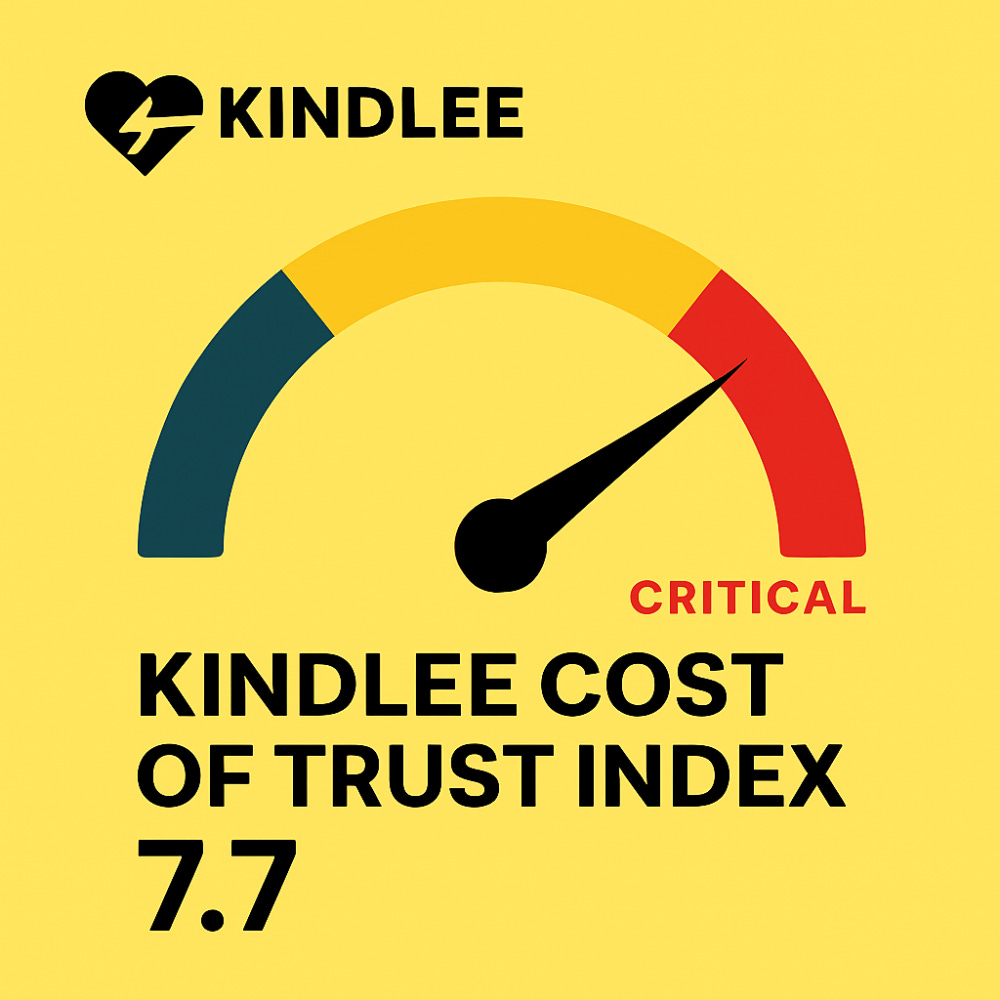
The Kindlee Cost of Trust Index (KCTI): Europe’s Financial System Average 7.7/10 - Critical
At the heart of our study — and of Kindlee’s innovation — lies the Kindlee Cost of Trust Index (KCTI): the first performance-based metric that measures fairness and accessibility across AI-driven financial systems.
The KCTI aggregates multidimensional data from real-world interactions — accessibility success rates, bias risk, compliance readiness to AI Act and EAA, escalation frequency, and user friction — to generate a unified, auditable score that reflects both ethical quality and financial efficiency.
In other words, KCTI gives leaders a way to see and manage fairness as a KPI. It bridges compliance, operations, and customer experience — revealing not just whether an AI system is compliant, but how much value it creates (or loses) through its fairness performance.
As more institutions benchmark against KCTI, Kindlee is building the first pan-European view of Responsible AI maturity, turning previously invisible bias into a transparent, industry-wide performance signal. KCTI transforms trust from a belief into a measurable business variable.
Why This Matters Now: The Clock Is Ticking.
The EU AI Act and European Accessibility Act already make AI accountability non-negotiable. Yet our data shows the readiness gap is widening. While many institutions have invested in accuracy, transparency, and cybersecurity, accessibility and representation remain the weakest links — and the most financially consequential.
At the same time, Generative and Agentic AI offer unprecedented potential for inclusion. When trained and governed responsibly, these systems can adapt to individual needs, translate across languages, and bring empathy back into automation.
The same technology that created the trust gap can, if managed correctly, close it.
Kindlee’s mission is to make that possible — to ensure that as AI grows more autonomous, it also grows more human.
The Opportunity Ahead
We believe the next phase of financial innovation will belong to the institutions that make fairness a business KPI. Measuring bias isn’t about meeting regulation; it’s about unlocking new markets, reducing friction, and proving that technology can serve everyone equitably.
To that end, Kindlee is Expanding its invite-only Benchmarking Program to help financial institutions measure their own Cost of Trust Index and seeking one additional Proof-of-Concept partner for Q1 2026.
The Future We’re Building
Our goal has never been to criticize the industry, but to equip it — with data, methodology, and hope.
Because fixing bias isn’t just about doing what’s right; it’s about making AI strong enough to represent everyone it serves.
As we scale the world’s first fairness-intelligence platform, we invite you to join us in turning compliance into confidence, and trust into growth.
💛
The Kindlee Team
Carla Canino
Founder & CEO, Kindlee